“The Second Coming” by William Butler Yeats

Much there is that's not right with the world. Thus today for National Poetry Month this old frightening visionary poem by William Butler Yeats.

The Second Coming

Turning and turning in the widening gyre
The falcon cannot hear the falconer;
Things fall apart; the centre cannot hold;
Mere anarchy is loosed upon the world,
The blood-dimmed tide is loosed, and everywhere
The ceremony of innocence is drowned;
The best lack all conviction, while the worst
Are full of passionate intensity.

Surely some revelation is at hand;
Surely the Second Coming is at hand.
The Second Coming!

Hardly are those words out
When a vast image out of Spiritus Mundi
Troubles my sight: a waste of desert sand;
A shape with lion body and the head of a man,
A gaze blank and pitiless as the sun,
Is moving its slow thighs, while all about it
Wind shadows of the indignant desert birds.

The darkness drops again but now I know
That twenty centuries of stony sleep
Were vexed to nightmare by a rocking cradle,
And what rough beast, its hour come round at last,
Slouches towards Bethlehem to be born?
“Green Canoe” by Jeffrey Harrison

Thoughts of summer and leisure are in the air. And lazy rivers and lakes. Thus this poem by Jeffrey Harrison for the 13th day of National Poetry Month.

Green Canoe

I don't often get the chance any longer
to go out alone in the green canoe
and, lying in the bottom of the boat,
just drift where the breeze takes me,
down to the other end of the lake
or into some cove without my knowing
because I can't see anything over
the gunwales but sky as I lie there,
feeling the ribs of the boat as my own,
this floating pod with a body inside it …

also a mind, that drifts among clouds
and the sounds that carry over water–
a flutter of birdsong, a screen door
slamming shut—as well as the usual stuff
that clutters it, but slowed down, opened up,
like the fluff of milkweed tugged
from its husk and floating over the lake,
to be mistaken for mayflies at dusk
by feeding trout, or be carried away
to a place where the seeds might sprout.

from Feeding the Fire (Sarabande Books, 2001)

“A Rainy Morning” by Ted Kooser

Today is the St. Louis Go! Marathon, so for this second Sunday of National Poetry Month here’s a poem about movement and grace by Ted Kooser.

A Rainy Morning

A young woman in a wheelchair,
wearing a black nylon poncho spattered with rain,
is pushing herself through the morning.
You have seen how pianists
sometimes bend forward to strike the keys,
then lift their hands, draw back to rest,
then lean again to strike just as the chord fades.
Such is the way this woman
strikes at the wheels, then lifts her long white fingers,
letting them float, then bends again to strike
just as the chair slows, as if into a silence.
So expertly she plays the chords
of this difficult music she has mastered,
her wet face beautiful in its concentration,
while the wind turns the pages of rain.

from Delights & Shadows (Copper Canyon Press, 2004)

“Grand Avenue” By Ron Koertge

Tomorrow is the St. Louis Go! Marathon, so for National Poetry Month here’s a poem by Ron Koertge about running, death, and love.

Grand Avenue

My wife and I were jogging, like we do every morning. Down Mission, left at Trader Joe’s, then up Grand Avenue and past the stately houses we will never be able to afford. We’d just turned the corner by Senor Fish, scattering a flock of pigeons strutting their stuff. One of them took off late, veered right into the path of a silver Lexus, then lay against the curb beating his one good wing like he was trying to put out a fire. My wife asked me to, for God’s sake, do something, so I turned the delicate head clockwise until I heard a click. Then darkness poured out of the small safe of his body. That is when I realized I used to merely love my wife. Now I would kill for her.

from Sex World (Red Hen Press, 2014)

“invention” by Tina Chang

For National Poetry Month today, here’s a beautifully grotesque poem by Tina Chang.

Invention

On an island, an open road
where an animal has been crushed
by something larger than itself.

It is mangled by four o’clock light, soul
sour-sweet, intestines flattened and raked
by the sun, eyes still watchful, savage.

This landscape of Taiwan looks like a body
black and blue. On its coastline mussels have cracked
their faces on rocks, clouds are collapsing

onto tiny houses. And just now a monsoon has begun.
It reminds me of a story my father told me:
He once made the earth not in seven days

but in one. His steely joints wielded lava and water
and mercy in great ionic perfection.
He began the world, hammering the length

of trees, trees like a war of families,
trees which fumbled for grand gesture.
The world began in an explosion of fever and rain.

He said, Tina, your body came out floating.
I was born in the middle of monsoon season,
palm trees tearing the tin roofs.

Now as I wander to the center of the island
no one will speak to me. My dialect left somewhere
in his pocket, in a nursery book,

a language of childsplay. Everything unfurls
in pictures: soil is washed from the soles of feet, a woman
runs toward her weeping son, chicken bones float

in a pot full of dirty water.
I return to the animal on the road.
When I stoop to look at it

it smells of trash, rotting vegetation,
the pitiful tongue. Its claws are curled tight
to its heart; eyes open eyes open.

When the world began
in the small factory of my father’s imagination
he never spoke of this gnarled concoction

of bone and blood that is nothing like wonder
but just the opposite, something
simply ravaged. He too would die soon after

the making of the world. I would go on
waking, sexing, mimicking enemies.
I would go on coaxed by gravity and hard science.


from Half-Lit Houses (Four Way Books, 2004)

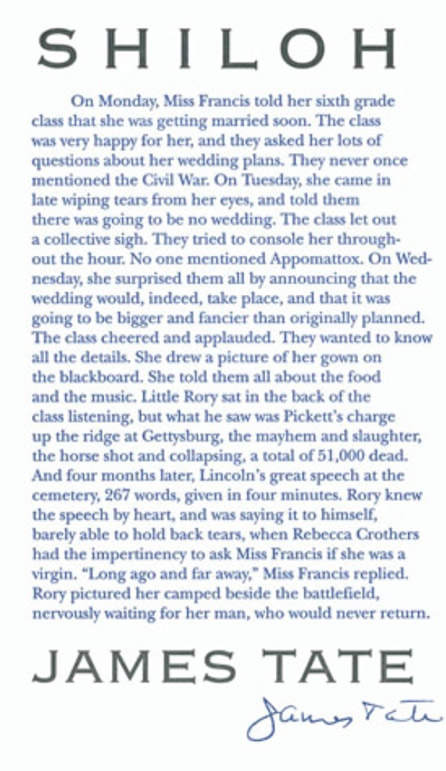
“Shiloh” by James Tate

150 years ago the American Civil War came to an end. Thus this poem today for National Poetry Month.

shilo

“All This and More” by Mary Karr

To kick off Week 2 of National Poetry Month, here’s a poem from Mary Karr’s The Devil’s Tour.

All This and More

The Devil’s tour of hell did not include
a factory line where molten lead
spilled into mouths held wide,

no electric drill spiraling screws
into hands and feet, nor giant pliers
to lower you into simmering vats.

Instead, a circle of light
opened on your stuffed armchair,
whose chintz orchids did not boil and change,

and the Devil adjusted
your new spiked antennae
almost delicately, with claws curled

and lacquered black, before he spread
his leather wings to leap
into the acid-green sky.

So your head became a tv hull,
a gargoyle mirror. Your doppelganger
sloppy at the mouth

and swollen at the joints
enacted your days in sinuous
slow motion, your lines delivered

with a mocking sneer. Sometimes
the frame froze, reversed, began
again: the red eyes of a friend

you cursed, your girl child cowered
behind the drapes, parents alive again
and puzzled by this new form. That’s why

you clawed your way back to this life.

“Springing” by Marie Ponsot

On the last day of the first week of National Poetry Month, here’s a poem from Marie Ponsot.

Springing

In a skiff on a sunrisen lake we are watchers.

Swimming aimlessly is luxury just as walking
loudly up a shallow stream is.

As we lean over the deep well, we whisper.

Friends at hearths are drawn to the one warm air;
strangers meet on beaches drawn to the one wet sea.

What would it be to be water, one body of water
(what water is is another mystery) (We are
water divided.) It would be a self without walls,
with surface tension, specific gravity a local
exchange between bedrock and cloud of falling and rising,
rising to fall, falling to rise.

“Call and Answer” by Robert Bly

For the first Monday of National Poetry Month, this by Robert Bly.

Call and Answer

Tell me why it is we don’t lift our voices these days
And cry over what is happening. Have you noticed
The plans are made for Iraq and the ice cap is melting?

I say to myself: “Go on, cry. What’s the sense
Of being an adult and having no voice? Cry out!
See who will answer! This is Call and Answer!”

We will have to call especially loud to reach
Our angels, who are hard of hearing; they are hiding
In the jugs of silence filled during our wars.

Have we agreed to so many wars that we can’t
Escape from silence? If we don’t lift our voices, we allow
Others (who are ourselves) to rob the house.

How come we’ve listened to the great criers—Neruda,
Akhmatova, Thoreau, Frederick Douglass—and now
We’re silent as sparrows in the little bushes?

Some masters say our life lasts only seven days.
Where are we in the week? Is it Thursday yet?
Hurry, cry now! Soon Sunday night will come.

“The Cows at Night” by Hayden Carruth

Before I run, here’s a poem by Hayden Carruth for this first Sunday of National Poetry Month.

The Cows at Night

The moon was like a full cup tonight,
too heavy, and sank in the mist
soon after dark, leaving for light

faint stars and the silver leaves
of milkweed beside the road,
gleaming before my car.

Yet I like driving at night
in summer and in Vermont:
the brown road through the mist

of mountain-dark, among farms
so quiet, and the roadside willows
opening out where I saw

the cows. Always a shock
to remember them there, those
great breathings close in the dark.

I stopped, and took my flashlight
to the pasture fence. They turned
to me where they lay, sad

and beautiful faces in the dark,
and I counted them — forty
near and far in the pasture,

turning to me, sad and beautiful
like girls very long ago
who were innocent, and sad

because they were innocent,
and beautiful because they were
sad. I switched off my light.

But I did not want to go,
not yet, nor knew what to do
if I should stay, for how

in that great darkness could I explain
anything, anything at all.
I stood by the fence. And then

very gently it began to rain.